MONORAIL TRAMWAY
Possibly the world's most obscure railway...

The engine and coach, saved by British Rail
Historian Mike Satow, operating at the Delhi Railway Museum .
Notice the single steel rail centered under the train and the balance wheel
running on a concrete strip which simulates the highway it ran on in regular
service. The rail carried aproximately 95% of the weight and the road or
balance wheel only 5%. 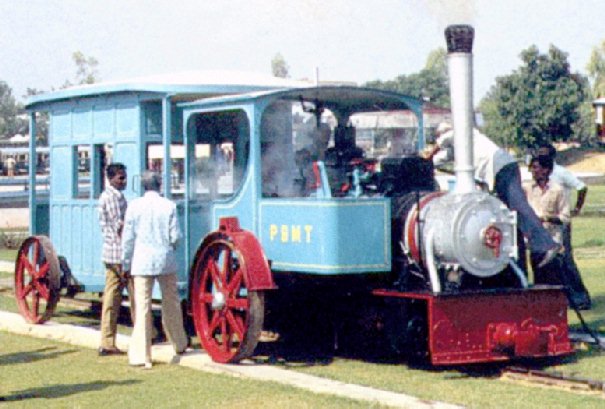

The Weather at the National Railway Museum


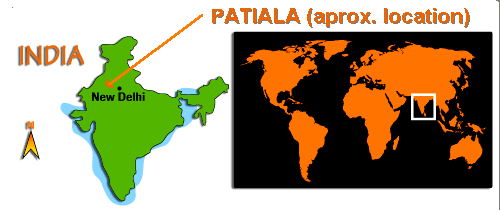
The subject of this net page is the Patiala State Monorail Tramway as built at Patiala in the Punjab area of northwest India.
 Into Obscurity
 The PSMT was begun in 1907. Within a few years the advent of cars and trucks had the same effect on this line as it did on so many others. In 1927 the line was closed and here again it became unique. While most abandoned rail equipment is soon fed to the scrappers torch and furnace, the PSMT's equipment was simply walked away from. For 35 years it rested where it was left. If it were not for a Mr. Mike Satow, a historian of things railroady in India, who discoverd the remains in 1962, it would have disappeared from memory by now and so this page is dedicated to him. Largely due to him, one engine was restored to full working order by the Northern Railway Workshops at Amritsar. They also reconstructed the Chief Engineer's private inspection car on an old underframe and the two were placed as an operating display at the National Railway Museum of India.

To view the NRMI site
The Ewing System
With only one rail and double flanged rail wheels, the Ewing System avoided all those problems. Laid out along the side of a road, it took up very little land. Since the road or balance wheel carried only 4% or 5% of the load, it did not subtract much from the steel wheel-steel rail efficiency. The track was no obstacle to vehicles crossing it. The downside was that the road wheel always ran in exactly the same path and on the softer surfaced roads of that day this sometimes tended to create a rut. This was evidently a problem of some magnitude for the PSMT. A double flanged wheel on one side and an unflanged wheel on the other side was also used by the Funnicular Railways although in that application, the unflanged wheel rolled upon another rail. Perhaps this was the inspiration for the Ewing system
A further advantage was the ability to use rather sharp radius curves. On a conventional railway, the difference in length or distance traveled between the inside and outside rails is a factor in Curve Resistance. In other words, the wheels on the inside rail travel a shorter distance than the wheels on the outside rail to get the vehicle around a curve and this has to be equalized by some means. On the Ewing System this was not a factor of any signifigance.
Think of it this way: A three legged stool always sits firmly, no matter where it's put down. A four legged piece of furniture needs an absolutely level floor and four exactly equal legs or it teeters. On a railway, the teetering lifts one flange high enought to cross over the rail head and off you go
It really did have a lot going for it...
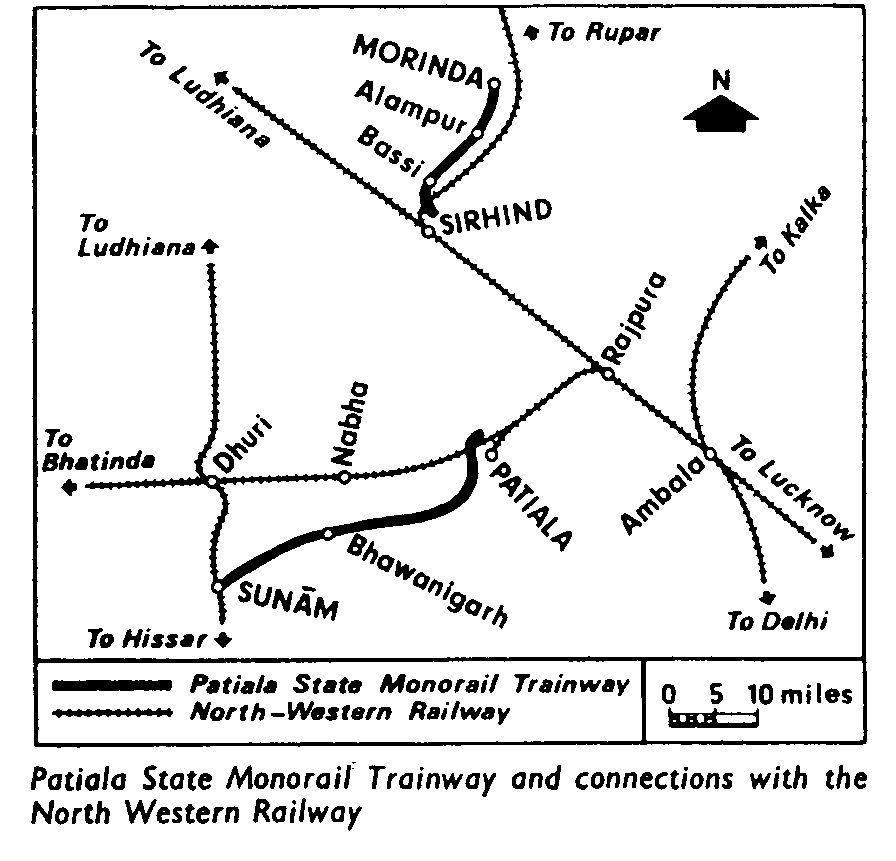 Actually the PSMT consisted of two unconnected lines. One ran 15
miles from Sirhind on the Northwestern Railway to Morinda. The other ran from
Patiala towards Sunam some thirty miles west and may possibly have never
reached its projected terminus.
Actually the PSMT consisted of two unconnected lines. One ran 15
miles from Sirhind on the Northwestern Railway to Morinda. The other ran from
Patiala towards Sunam some thirty miles west and may possibly have never
reached its projected terminus.
From searching the internet it has been established that the area through which the line ran is basically flat or slightly rolling country. Thus it seems that there would not have been any great engineering works. There may have been some irrigation canal bridges but that is pure guessing
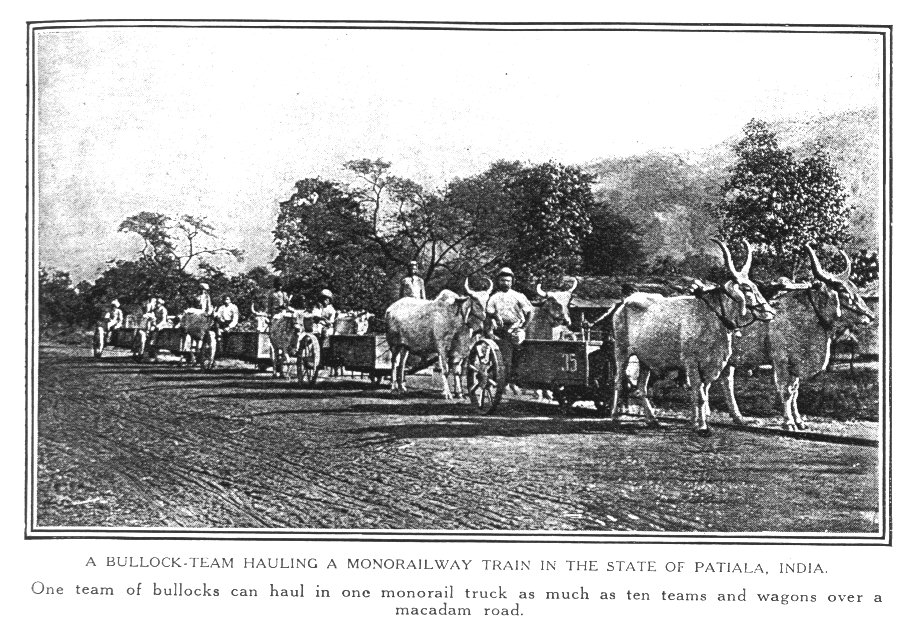
The area was and is a grain producing area (sometimes called the wheat bowl) and the best guess is that crops were the primary freight. These old pictures show small cars loaded with sacks. This could be a scene on the Sirhind - Morinda line or the Patiala - Sunam line as animal power was used on both.
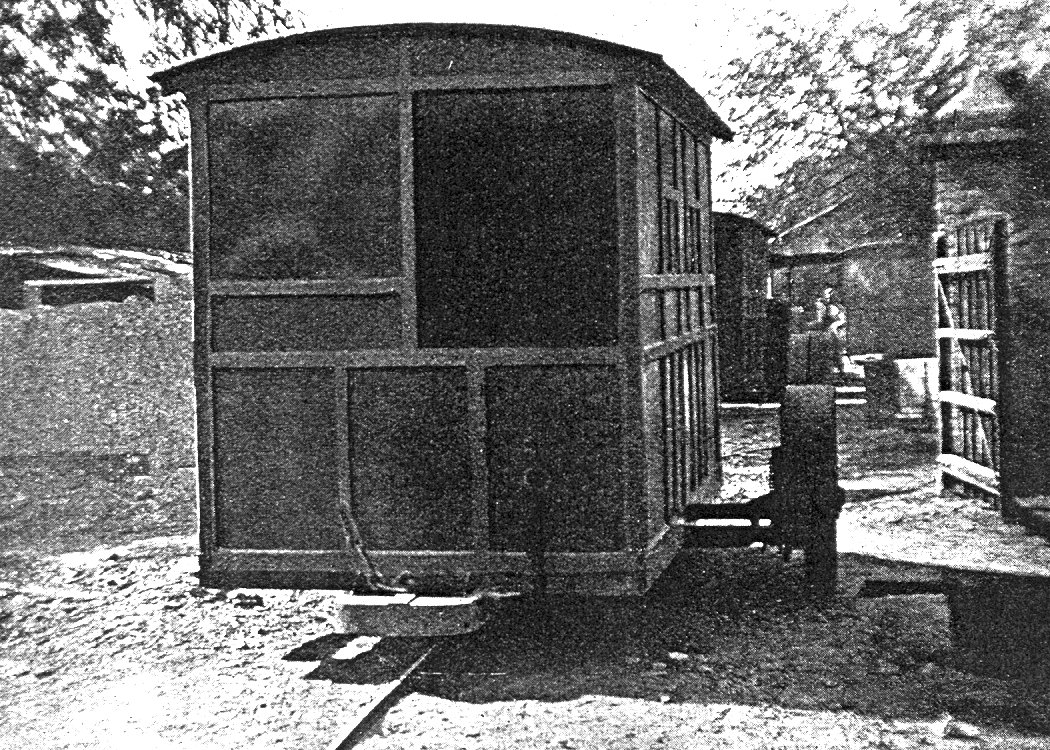
What passenger traffic it had is unknown other than what is stated in the article by H.R. Ambler. The picture above from an old book seems to show at least two small passenger cars but the location remains a mystery. The passenger car on display at the National Railway Museum is actually a reconstruction (on a recovered actual running gear) of the private inspection car of the line's chief engineer, Col. Bowles.
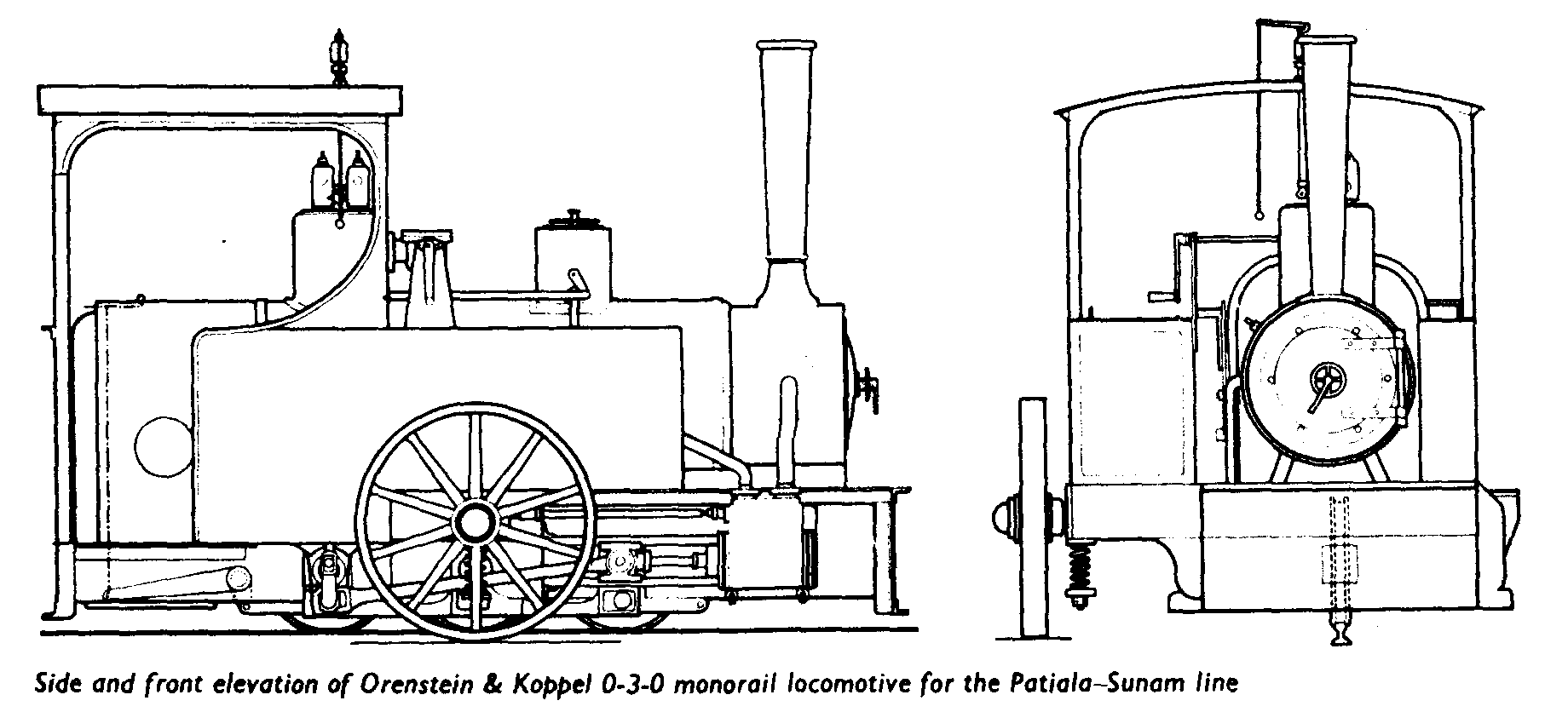

The above picture shows a three or more car train pulled by an obviously home built gas powered loco. The caption for the photo says that the engine was taken from "an ordinary motorcar". This experiment by Col. Bowles was the exception to animal power on the Sirhind - Morinda line. This 1920's venture was quite possibly the first locally built, internal combustion locomotive on the Indian sub-continent.
As this writer worked at pulling together what was known of the PSMT, it became more and more obvious that there were one or more documents out there somewhere that others had access to. Finally a copy of that document was sent me. Railway Magazine carried in 1969 an article by H. R. Ambler about this obscure monorail. Railway Magazine has extended permission to have the article scanned and included here for which many thanks are given. If you read it carefully you will see the two mischances that erased much of the history of this line. Mr. Ambler mentions accessing archives at Patiala. Let us hope that he obtained all that was available there since this writer has never found any person or organization able and willing to help with contacting those archives
The quality of these scans is less than best. I had to start with a copy mauled by the post office, made from an old magazine, on a rather indifferent copy machine. They have been extensively manipulated in a graphics program. Using a higher resolution scan would have made them clearer but took too much bandwidth. I think you will still enjoy reading H. R. Ambler's words.
Your Back button on your browser will return you here.
The National Railway Museum guide book says that mules were used at one time. BBC (British Broadcasting) did a video of Indian Railways and showed Mike Satow visiting the rusted remains he found in Patiala. In a brief glimpse of a car underframe, there appears to be an electric motor driving one or more wheels.

.
Special Thanks to:
Ruediger Fach of the Frankfurt Feldbahn Museum for two pictures showing the preserved locomotive and reproduced car in action at the museum in New Delhi.
Keith Manison of Kingston, Jamaica for copies from a 60+years old book.
Anne Ogborn of New Delhi and Oakland, CA USA for on-site observations and much help in obtaining further information. Anne suggested we from a PSMT fan club. I said that we had and that we were the only two members...
Kelvin Parkes of Bad Vilbel, Germany for copies from an old engineering encyclopedia.
Ralf Schriener of Wurms,Germany for a picture and for listing the PSMT in the research column of his site. His Light Railway site covers other railways used in similar situations and is well worth a visit. http://www.feldbahn.de
S. Shankar of Poona, India who found information for me in the guide book of the National Railway Museum of India
Prakash Tedulkar of Los Angeles, USA for permission to link to his pictures of the PSMT. A very nice set of pictures

If you have any information , photos, or drawings
regarding this line, its equipment, route, engineering works, operations or
of the area it ran through, please contribute to its history.
---If you have any Railroad Encyclopedias of the 1900 to 1920 era, please check
them to see if they have any information about this railway and if they do
please contact me---.
Email information or comments to webmaster@irfca.org.
© Donald W. Dickens, 1998
Last updated December 12, 2003 by Tjalling Ament
Would you believe, these pages have been paid the compliment of being copied in part by a site concerning Patiala. They even had the gall to claim my text under their copyright notice.
